
Who Should Choose the Excess 14? A Buyer Profile Guide
A detailed buyer-profile framework to evaluate whether the Excess 14 aligns with your cruising ambition, operating discipline, and ownership economics.
Read article
A practical, experience-based guide to windy catamaran docking with repeatable habits that reduce stress and improve crew confidence over a full first season.
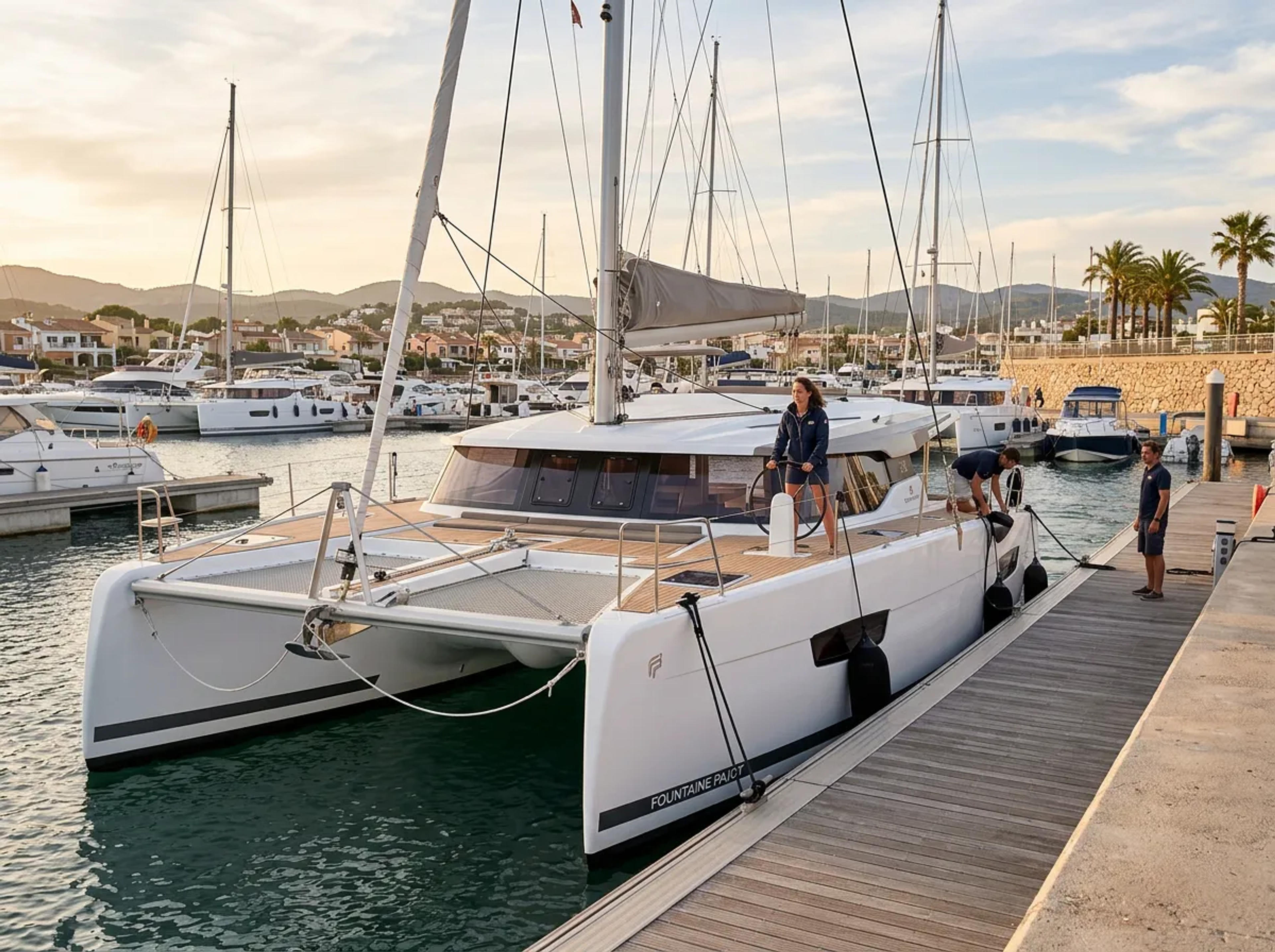
If your first windy docking experiences felt tense, you are not behind. You are normal.
Most new catamaran owners are surprised by how different marina maneuvers feel compared with open-water sailing. In open water, small imperfections are often absorbed by space and time. Inside a marina fairway, every decision gets compressed. Wind seems stronger, distances feel shorter, and communication errors show up immediately.
That does not mean docking in wind is chaotic by nature. It means the maneuver rewards structure more than improvisation. Once you build a repeatable routine, your stress level drops, your crew starts anticipating each step, and the boat begins to feel predictable again.
If you are still shaping your ownership plan, start with our Excess models overview and ownership planning resources so your training priorities match your real use case.
The core difficulty is not one single technical skill. It is cumulative mental load.
At the same moment, you are processing angle, speed, wind pressure on the hull, fairway traffic, crew positioning, and timing at the dock. New owners often assume confidence will arrive by sailing more miles offshore, but close-quarters confidence grows faster through focused marina sessions.
Another hidden challenge is decision latency. When the approach starts to drift from plan, many skippers wait one beat too long to correct or reset. That delay creates a cascade: larger rudder input, more throttle, rising crew tension, then unclear commands. Good docking habits are designed to break that cascade early.
The calmest docking crews are not the most talented crews. They are the crews that agree on a simple plan before entering the basin.
In practice, confident docking starts long before the fairway entrance. You brief the sequence, identify your abort trigger, and assign one clear role per person. The goal is not to perform perfectly. The goal is to reduce surprises.
The ten habits below are useful because they work together:
These are not advanced tricks. They are reliability habits. When repeated, they convert a stressful maneuver into an operational routine.
Top tip
Rig dock lines in order of use before entry. In stronger wind, every second saved before contact matters because your margin disappears quickly.
Instead of waiting for random difficult days, build progression intentionally.
Week one might focus on low-wind entries with emphasis on speed control and clear crew calls. Week two can add tighter approach geometry. Week three introduces crosswind and controlled aborts. By the end of this cycle, you are not just better at one marina. You are building a maneuver framework you can carry anywhere.
This progression also helps crew confidence. New crew members do better when they know what success looks like for the day. If the objective is "clean communication and one early reset," that is measurable and realistic. If the objective is "dock perfectly no matter what," stress usually wins.
Reliable pre-brief data supports better choices on the water:
Use those sources to answer practical questions, not abstract ones: is crosswind trend increasing at your target time, is current helping or opposing your preferred approach, and do you still have a safe reset option if traffic builds.
A short, honest debrief after docking is the fastest path to progress.
Ask only three questions: what worked, what became unstable, and what single change will we apply on the next approach. Keep it factual. Avoid blame language. The point is to improve the system, not to judge people.
If you run that loop consistently, your marina confidence compounds quickly, especially when paired with 7 common first-season mistakes and first-year budget discipline, which keeps training momentum realistic.
Target the minimum speed that still preserves steerage and timing control. On a catamaran, excess speed often creates more problems than it solves because inertia and wind pressure quickly magnify small mistakes near the dock. If your angle starts to degrade, a clean reset is usually safer and faster than trying to force a compromised approach. Over time, you will find a repeatable speed window that fits your marina geometry and crew rhythm.
There is no universal answer, and that is exactly why routine matters. The right choice depends on slip orientation, wind direction, fairway width, and your practiced sequence with this crew. Instead of chasing "best technique" online, choose one method that matches local conditions and train it until everyone can execute calmly. Consistency under moderate pressure is usually better than switching methods every outing.
Keep briefs short, specific, and role-based. Each person should know one primary task, one backup task, and one stop command. Avoid multi-step speeches at the last minute; they are hard to remember under stress. A strong brief gives the crew a shared picture of success and a shared language for reset.
Abort as soon as one of three signals appears: speed no longer matches plan, final angle is no longer recoverable with small corrections, or communication becomes unclear. Early resets protect the boat, the crew, and your confidence. Waiting too long usually forces larger inputs and increases risk. Treat aborting as a professional decision, not a personal failure.
Yes, especially in variable wind. Pre-positioned fenders and lines convert emergency reactions into planned actions, which lowers stress for everyone onboard. Last-second setup often steals attention from helm control at the exact moment the skipper needs focus. Think of fender prep as part of navigation, not a separate housekeeping task.
Most crews feel a real difference after three to five focused sessions, provided each session has one clear objective and a short debrief. Improvement is rarely linear: one day feels great, the next feels average, then confidence jumps again. What matters is consistent repetition with small corrections. Over a season, those small corrections become reliable skill.
Keep reading for more Excess updates, sailing tips, and stories from the cruising community.
A detailed buyer-profile framework to evaluate whether the Excess 14 aligns with your cruising ambition, operating discipline, and ownership economics.
Read articleA deeper practical analysis of why the Excess 13 is often a strong California balance point between sailing feel, onboard usability, and ownership flexibility.
Read article