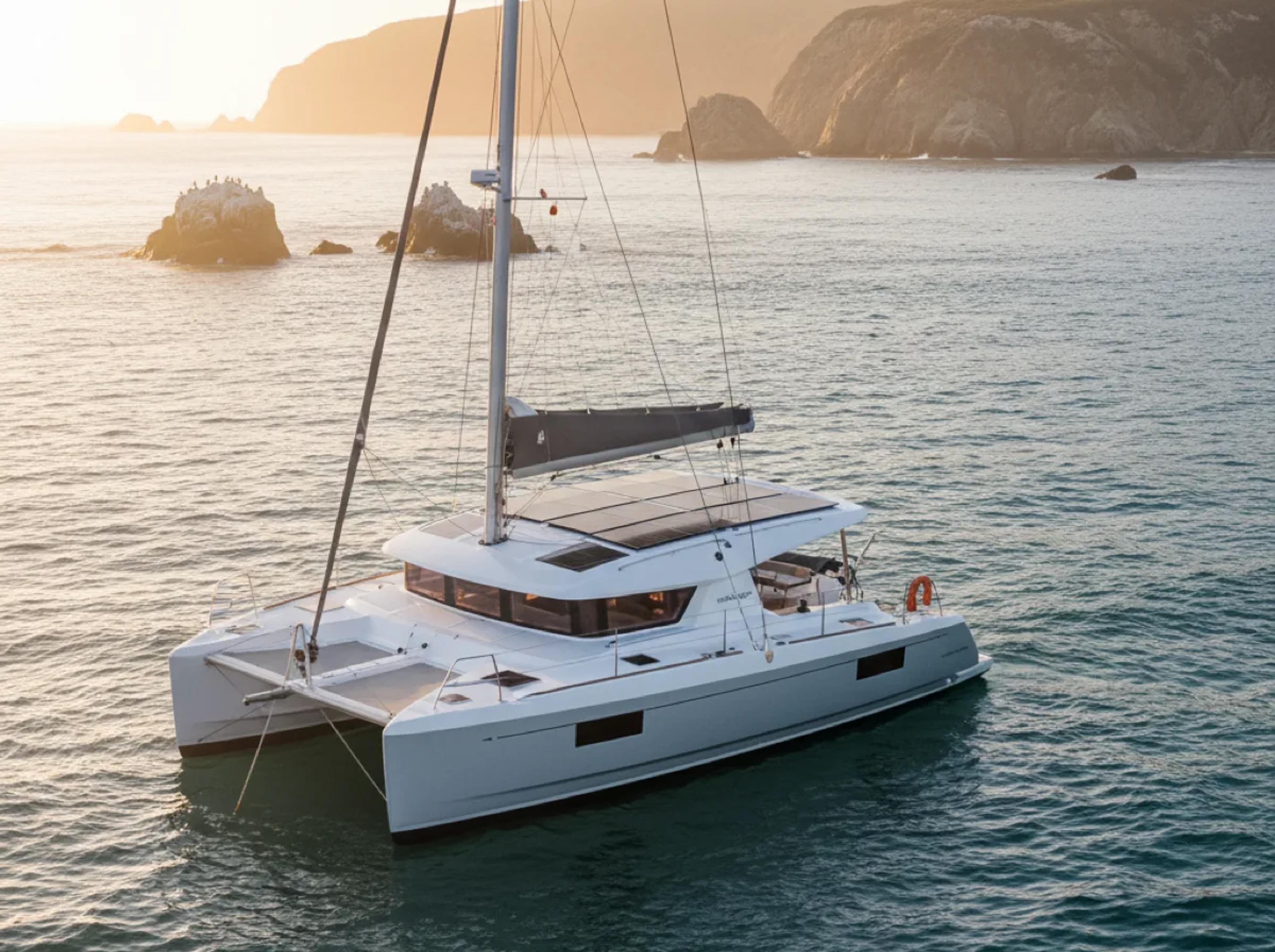
Why your power and water budget starts before you cast off
Picture a family of four leaving San Pedro on a Friday evening, bound for a week that mixes Catalina's Two Harbors with an anchorage at Santa Cruz Island. Everything about that trip is decided before the lines come off: how much catamaran solar power you carry, how full your water tanks are, and whether your house bank can carry a night of lights, a fridge, and the autopilot's passage-day draw. Get those numbers right and the week is quiet, self-sufficient, and restful. Get them wrong and you spend the trip hunting a generator plug or rationing showers — a problem no anchor, however pretty, can solve.
That is the mindset shift most new owners miss. A catamaran's electrical and water systems are not separate checklists; they are one integrated plan, sized against the same trip. This guide covers what an Excess carries from the factory, how to budget power for a weekend versus a week, how to size solar for Southern California's sun, and why water — not power — usually bites first.
What an Excess catamaran actually carries (batteries, solar, and tankage)
Before you plan anything, know your starting point. The factory figures below hold across the Excess model range, and they are the baseline your planning builds on.
- Fresh water: all three models ship with a 300 L (79 US gal) tank as standard, with a +300 L option that brings total capacity to 600 L (about 158 US gal).
- Service batteries (Excess 11): 2 × 140 Ah AGM batteries as standard; the Electric Pack adds two more, for 4 × 140 Ah.
- Charging: 2 × 125 A alternators and a 40 A battery charger; a 25 L water heater runs off the hot water circuit.
- Solar: there is no factory solar on any Excess model. Panels, controllers, and mounting are an aftermarket or dealer-installed step — which is exactly why planning ahead matters.
Two details are worth flagging. First, the optional second water tank is the single most useful factory option for weeklong cruising — and it matters most on the smallest model, where our realistic use cases for the Excess 11 show the difference between a four-day and an eight-day range. Second, the local geography: water is available year-round at Catalina's Two Harbors fuel dock, but the Channel Islands National Park anchorages have no marina services — potable water only at a few limited onshore locations. The official Excess model specifications confirm the factory numbers.
Building a realistic power budget for a weekend and for a week
Every useful power plan starts with loads, not panels. Total what you actually draw on a typical day, and the rest of the system — solar, alternator time, battery size — follows from that number.
- Fridge and freezer draw per day, averaged over compressor cycles
- 300–500 Wh
- Autopilot on a full sailing day (sea state dependent)
- 150–400 Wh
- Instruments, lights, and VHF standby
- 150–250 Wh
- Phones, tablets, and small USB electronics
- 80–150 Wh
Add those up and a typical anchor day lands around 600–1,200 Wh; a passage day runs higher because the autopilot is working. That range is the foundation of your planning — the Boat Solar Calculator uses exactly this method, starting from daily draw in amp-hours and backing into panel wattage.
The weekend case is easy: leave with batteries full and the standard 280 Ah AGM bank on an Excess 11 carries a three-day weekend — roughly 140 Ah usable (keeping AGM above about 50% depth of discharge) covers a couple of nights at anchor. The week case is different: you must recharge every day, through solar or engine time, or the bank slowly bleeds out. Our month-by-month first-year budget guide covers what those upgrades cost.
The rule for anchor-day autonomy is simple: a weekend is fine on the standard bank; a week needs 400–600 W of solar or 1–2 hours of engine charging every other day. Our anchoring playbook for Southern California catamaran owners covers the anchorage side — where the holding is good and how long owners stay out.
Sizing solar for Southern California sun
Solar sizing for a boat is not residential math. Panels lie flat, salt spray coats them, rigging shades them, and mornings and late afternoons are weak — so a marine array's practical output is only about 60% of its rated wattage. The formula is:
Daily Wh ÷ (peak sun hours × ~0.6 marine derate) = solar watts you need
Southern California gets roughly 4–6 peak sun hours depending on season — excellent by world standards, but the derate still applies. An anchor day near the top of the range, say 1,200 Wh, divided by (5 PSH × 0.6) gives about 400 W. So a 400 W array carries a fridge plus instruments on a good day, and 600 W adds margin for autopilot and overcast stretches. Some Excess 14 owners go further — one documented 2,500 W / 1,200 Ah LiFePO4 setup (sv-hullyeah.blog, an owner blog) — but 400–600 W is the practical target.
The controller matters as much as the panels. An MPPT controller is mandatory — a PWM unit wastes 25–30% of the array. And mounting space counts: on the Excess models the clean options are the hardtop roof and a davit or arch mount. Flat coachroof panels are the easiest install; an arch keeps panels clear of boom and mast shadows and suits a serious array.
Battery chemistry is the other half. AGM banks should stay above roughly 50% depth of discharge, halving usable capacity; a LiFePO4 upgrade unlocks 80%+ usable capacity, charges faster, weighs less, and is what makes a week without shore power comfortable rather than a constant calculation. One planning consequence beyond budget: any lithium retrofit should be declared to your insurer — our California catamaran insurance guide covers this in detail.
Water: the constraint everyone forgets
Power gets all the attention; water quietly ends trips. The Boat Galley's water usage research gives the honest spectrum: about 1 US gal per person per day is extreme conservation, 4–6 gal per person per day is comfortable-conservative, and 10+ gal a day appears the moment daily showers enter the routine. A family of four at a relaxed 5 gal per person works through about 20 gal a day.
Now the tankage math. The standard 79 gal tank supports four people for roughly 3–4 days; the +300 L option roughly doubles that to 7–8 days — the difference between a Catalina weekend and a real Channel Islands week with no resupply. The second tank is the factory option to check first, and our family cruising setup guide shows the shower and galley habits that make or break it.
The local reality sharpens it. At Catalina, top up water and ice at the Two Harbors fuel dock year-round, though the island can impose water rationing at any time — the land and marine services page advises filling tanks before leaving your home port. At the Channel Islands, anchorages have no services at all; the National Park Service provides potable water only at a few limited onshore locations, so a week of anchorages carries everything with you. Plan against that reality with our weather windows guide for new catamaran owners.
Top tip
Plan water in gallons per person, not in "full tanks." A full 79 gal tank sounds like a lot until you divide it by four people and 5 gal per person per day — then it is three days. Add the second tank or plan a Catalina fuel-dock top-up, and the math flips from rationing to relaxing.
For the typical program, a watermaker is out of scope — its power draw and cost pay off only for extended cruising. Get tankage and island water strategy right first; that covers 95% of real trips.
The weekend-to-weeklong planning checklist
Pull the whole plan into one pre-departure pass. Ten minutes on the dock beats a day of scrambling at anchor.
- Fill every tank. Water is never guaranteed past Catalina; assume you start full and plan what happens when you are not.
- Know your battery baseline. Check resting voltage and state of charge before you leave — do not discover a tired bank at anchor.
- Set a solar expectation. If you have panels, know what a good day actually produces (rated watts × ~0.6, not the label).
- Agree the engine top-up rule. For a week without shore power, decide the alternator schedule in advance — 1–2 hours every other day is a sane default.
- Run the loads consciously. Fridge on eco, lights off in empty spaces, autopilot off at anchor. Discipline converts directly into usable amp-hours.
- Plan the island water and ice strategy. Catalina: top up at Two Harbors when you pass. Channel Islands: everything with you, no exceptions.
That checklist, plus the tankage and panel math above, is the whole planning framework — and if you are still choosing between Excess models, these numbers decide between trim levels and options.
Plan your systems before you spec your boat
The best time to decide is before the order goes in, when factory options — the second water tank, the Electric Pack, solar-ready install planning — are still choices on paper. The second-best time is this fall, while the boat is off-season in the yard. Our ownership resources cover the full process, and we can help you run the numbers against your actual cruising program.
Frequently Asked Questions
How many solar watts does a catamaran need for a week without shore power?
A practical target is 400–600 W for a typical Southern California week. Run the formula — daily watt-hours divided by (peak sun hours × ~0.6 marine derate) — and 400 W covers a fridge and instruments on a good day, while 600 W adds margin for autopilot and overcast stretches. With 4–6 peak sun hours locally, that recharges an anchor day before sunset in most seasons.
How long does 300 L of water last on a catamaran?
The standard 300 L (79 US gal) tank lasts about 3–4 days for a family of four at roughly 20 gal a day, and longer for a couple. The +300 L option roughly doubles that to 7–8 days. The swing is all in habits: conservative users at 4–6 gal per person per day stretch much further than daily-shower users at 10+. That is why the second tank is the option to check first.
Can the standard AGM batteries handle a week anchored out?
Not on their own. The standard 280 Ah AGM bank offers about 140 Ah usable (staying above 50% depth of discharge), which is roughly one day at anchor with a fridge running. For a week you need daily recharge — solar or 1–2 hours of engine time every other day — or a lithium upgrade, which pushes usable capacity to 80%+ and changes the answer entirely.
Do I need a generator for a weeklong catamaran trip?
For typical no-air-conditioning cruising, no — solar plus the engine alternators covers a normal week. The moment heavy inverter loads, air conditioning, or extended motoring in light wind enter, reassess: those loads change the whole equation. If A/C at anchor is a hard requirement, budget for it explicitly rather than discovering the gap mid-trip.
Is the Excess Electric Pack worth it?
The Electric Pack's two extra 140 Ah service batteries (4 × 140 Ah total) are genuinely useful for weeklong cruising without shore power — they roughly double your usable AGM capacity. But they still need daily recharge; pair them with solar for real autonomy. Think of the pack as capacity now and a foundation for a future lithium or solar upgrade, not a replacement for generation.
Where can I fill water and ice between Catalina and the Channel Islands?
At Catalina, the Two Harbors fuel dock sells gas, diesel, and water year-round, with ice onshore — though water rationing can be imposed at any time, so fill before departure. At the Channel Islands National Park, anchorages have no services at all; potable water exists only at a few limited onshore locations.
What is the difference between AGM and LiFePO4 for a cruising catamaran?
AGM is the standard: about 50% usable capacity, heavier, fewer cycles, and no management beyond keeping it above half. LiFePO4 offers 80%+ usable capacity, roughly 60% less weight for the same energy, much longer cycle life, and faster charging acceptance — at a higher upfront cost. For weekends the standard AGM bank is fine; for week-long autonomy, lithium is the upgrade that makes the math work.