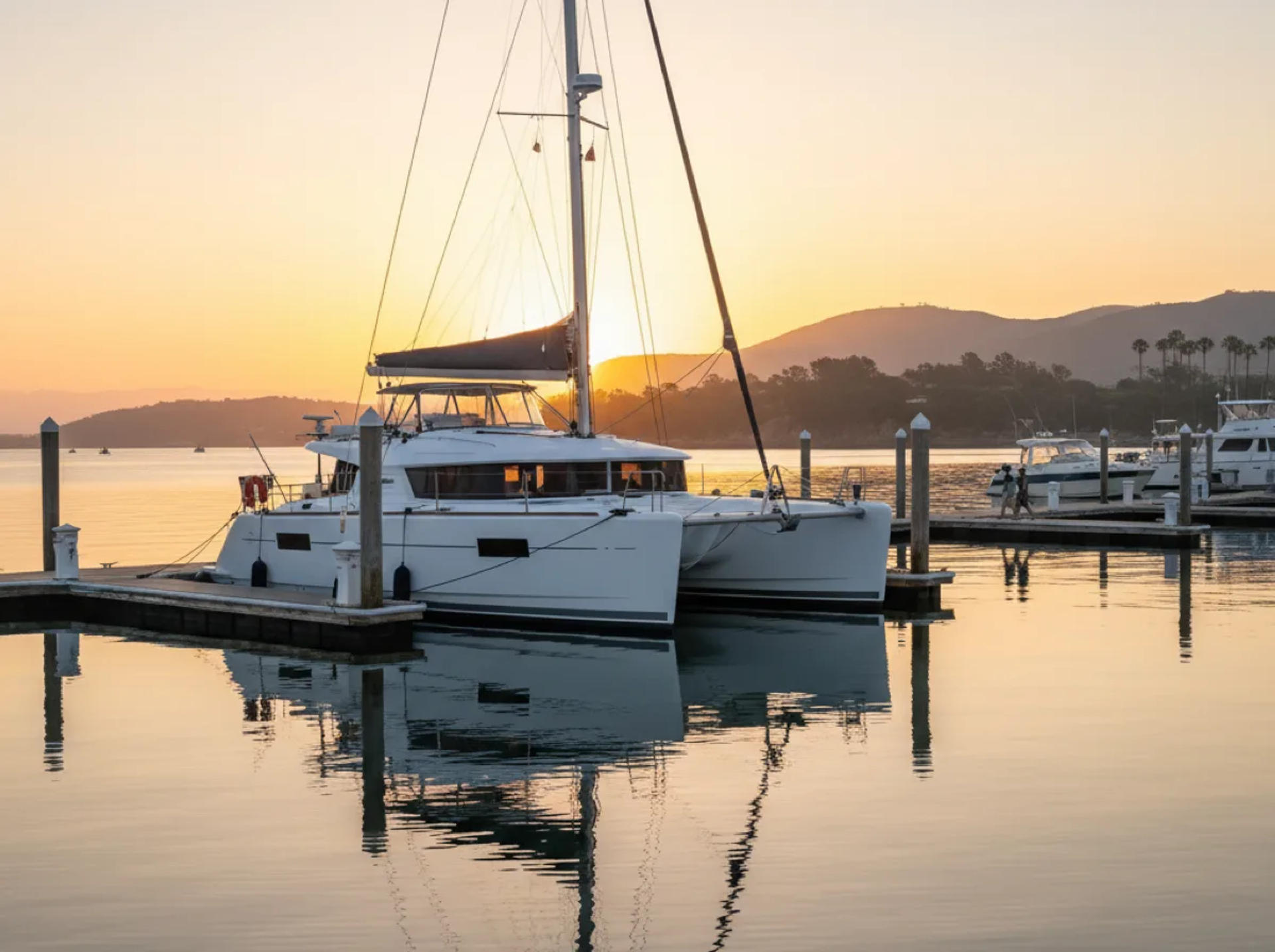
One Weekend Is Enough, If You Arrive With a Filter
The gate opens at nine. Twenty minutes later the dock is crowded and a familiar drift begins: walk the whole dock, board whatever looks good, keep the one with the nicest galley in mind, go home.
Knowing how to buy a catamaran at a boat show is mostly a question of sequence, not stamina. You are not there to buy a boat. You are there to cut a list of eight or ten models down to three, and three down to one, with enough written evidence to defend the choice to your partner three weeks later.
That fits in one weekend. It does not fit if you board everything. The plan below runs on three passes, one beam measurement, one score sheet and a 72-hour decision window.
The Southern California Calendar, and What Each Show Is For
Three shows sit within driving distance, and they are not interchangeable.
The LA Boat Show runs January 29 to 31, 2027, across the Long Beach Convention Center and the Sports Arena. It is the region's largest indoor floor, useful for walking a whole range without weather getting a vote. Use it as your range show: layouts, volumes, price positioning.
The Newport Beach International Boat Show runs April 15 to 18, 2027, at Lido Marina Village. It happens on floating docks, so the waterline does its honest work and the helm sightlines read true.
The San Diego International Boat Show is listed for June 2027 at Safe Harbor Sunroad, with more than 150 vessels. Exact dates were not published when this was written; confirm them before booking travel.
If you would rather see the process run live, Sail Pacific hosts an open house in San Pedro on Saturday, November 21, 2026, with sea trials on an Excess 13.
Write the One-Page Brief Before You Park
A show rewards preparation more than enthusiasm. This is the catamaran boat show checklist worth writing before you leave the house: one page, five lines.
- Who sails, and how many sleep aboard.
- The longest trip you will realistically take in year one.
- The slip you have, or the beam your marina can actually take.
- A budget that includes the first year, not only the purchase price.
- Three must-haves and three dealbreakers, in your own words.
The last line does the heavy lifting. "Easy to handle" is not a criterion. "I can raise and reef the main alone in 15 knots" is. Read the first-year budget breakdown before you set the number: insurance, berthing and commissioning move the total more than most buyers expect.
Top tip
Get financing pre-qualified before the show, not during it. A number in hand turns "what would this cost per month" into "does this boat fit the plan," and it keeps a dock conversation from becoming a credit application.
Pass One: Ninety Minutes on the Floor, No Boarding
Walk the dock once without stepping onto a boat. Most buyers do the opposite, and the first catamaran they board becomes the reference point for everything after it.
Note the model, the beam, the displayed price, whether the boat floats or sits on stands, and one sentence about the layout as seen from the dock. Photograph the spec sheet, not the boat. Cross off anything that fails a dealbreaker on paper: three cabins when you need four, an owner's hull on the wrong side, a beam your marina cannot take.
Ninety minutes covers eight boats if you keep moving, and ends with three names circled.
Pass Two: Three Boats, Five Identical Questions
Board only the three you circled. Ask the same five questions on every boat, in the same order, and write the answers down as they are given.
- Which cabin is the owner's, and can two couples share this boat for a week without negotiating over it?
- How does the main go up and come down with two people, in wind, without leaving the helm?
- What do the engines and charging system support over four days at Catalina, with the fridge running?
- Where do wet gear, provisions for six and a dinghy actually live?
- What is in the displayed price, and what is an option on the sheet you were handed?
The fourth separates boats faster than any brochure. The fifth catches the gap between a show price and a delivered price, which is often the whole gap between two models.
If the model choice is still open, our Excess 11 vs 13 vs 14 comparison covers the crew and layout logic behind each size.

The Beam Test Most Buyers Skip
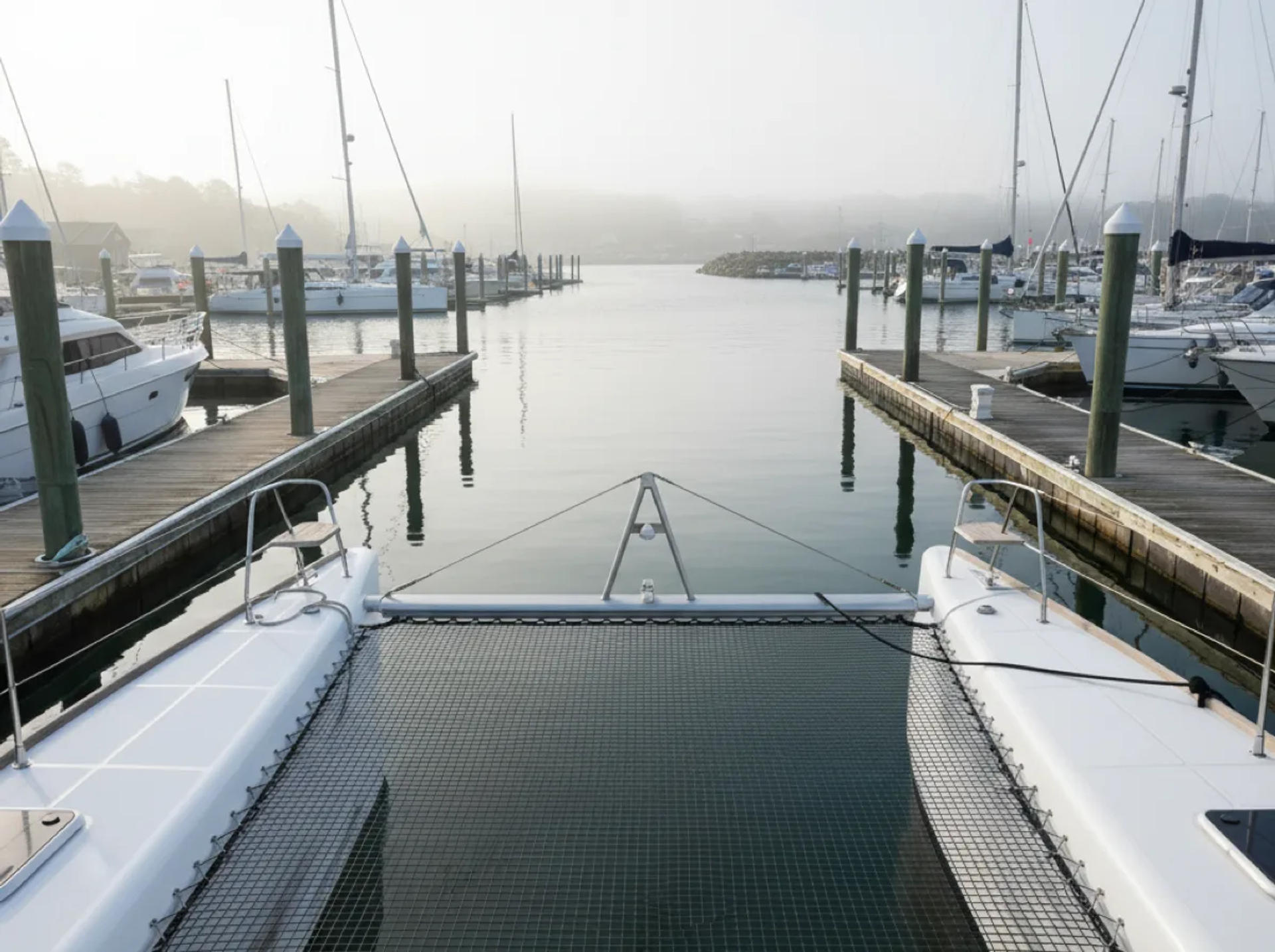
Beam decides where the boat lives, and the show floor makes it hardest to judge. Treat this as the Excess beam and slip fit test, not a spec-sheet exercise. On the dock, every catamaran looks wide. In a slip, six inches is the difference between a routine docking and a monthly argument with a piling.
The published Excess specifications give a clean spread:
- Beam of the Excess 11, on a 37'5" length overall
- 21'7"
- Beam of the Excess 13, on a 42'7" length overall
- 23'9"
- Beam of the Excess 14, on 45'9" to 52'5" depending on version
- 25'9"
Step onto the foredeck of each boat and look down the fairway between the hulls. Then call your marina with the number in hand, not the model name, and ask what beam they can berth and how the waitlist looks. A slip advertised as 24 feet wide does not give you 24 feet between the fingers once fenders, cleats and tolerance are counted. Our guide to marina slip strategy in Southern California covers the calls worth making before you commit to a beam.
What the Show Floor Cannot Tell You
A show answers questions about space and almost none about behaviour. You can learn where the galley sits. You cannot learn how the hull sounds at anchor in swell, how much ventilation the cabins get on a hot August night, or whether the helm gives a clear view of the starboard bow coming alongside.
Write those down as sea-trial items instead of guessing: motion under power, engine noise in the aft cabins, visibility from both stations, engine bay access, dinghy launch and recovery, storage left once the boat is loaded for a real trip. Our Excess sea trial checklist is built around that gap between what a floor shows and what water reveals.
A dealer who answers "we will run that on the trial" is telling you something useful. One who answers every question from a brochure is telling you something too.
Sunday at Four: Score, Rank, Then Book
Score each shortlisted boat on five criteria, weighted to 100, and be honest about which weights are yours and which are your partner's.
| Criterion | What a top score looks like | Weight |
|---|
| Crew and trip fit | Berths, heads and storage match the people and the longest trip on your page | 30 |
| Handling confidence | You can picture reefing and docking it with your own crew, in your own weather | 25 |
| Ownership envelope | Purchase, first year, slip and insurance all fit without a stretch | 25 |
| Answers in hand | Fewer than three questions left that only a sea trial can settle | 10 |
| Alignment | Everyone who will sail her ranks the same boat first | 10 |
Then start the 72-hour clock. Within three days, send one email per shortlisted boat with three lines: the configuration you are considering, the two open questions, and the next step you want with a date on it: a sea trial on a named Saturday, a written quote.
Silence from the dealer of the boat you ranked first is information too.
The Thirty Days Between Shortlist and Signature
The weekend ends with a ranking. Signature should not follow in the same week: the boat show follow-up sea trial is the appointment that converts a ranking into a configuration, and several other items run on other people's calendars.
Put these in order: sea trial date, written configuration and option list, financing approval, insurance quote, slip confirmation, delivery or build slot in writing. Quotes come back in days. Slips and build slots move in weeks or months, which is why they belong at the top of the list.
Insurance deserves its own call rather than a line on a form. Premium depends on cruising area, crew experience, storage and the agreed value you choose, and the spread between two quotes on the same boat can pay for a season of berthing. Our guide to catamaran insurance in California explains which variables move the number, and the ownership overview covers what year one looks like once the boat is yours.
Five Ways a Good Weekend Becomes a Wasted One
- Boarding everything. Twelve boats in a day leave no memory and no comparison.
- Negotiating before the sea trial. Price talk before you know how the boat handles trades your position for a number you cannot evaluate.
- Comparing sticker prices across unequal specs. Base price against loaded price is a discount conversation, not a comparison.
- Collecting brochures without names. Paper with no dealer, no boat and no question attached is recycling.
- Leaving without a date. A weekend that ends without a scheduled next step becomes a research project that quietly expires.
The weekend should produce a ranked list and a calendar entry. With both by Sunday evening, the show did its job. If you are still deciding whether a catamaran is right for you at all, that is a different weekend, better had on the water.
Frequently Asked Questions
Can you actually buy a catamaran at a boat show?
Yes, and dealers will take a deposit on the dock. The better use of the show is to narrow the field and book the next step: a decision made without a sea trial, a written configuration and a slip confirmation rests on incomplete information. Board three, rank them, then let the sea trial and the paperwork decide.
How many catamarans can one person evaluate in a weekend?
Three, well. Four if you are disciplined. A walk-through takes 20 to 30 minutes once you ask the same five questions, and comparison only works when your notes hold the same shape across boats. Boarding ten sounds efficient and leaves one long white interior and no usable detail.
Are boat show prices better than a dealer's?
Sometimes, usually as a package of options or a delivery slot rather than a headline discount. The honest comparison is delivered price: base boat, options, commissioning, delivery and first-year costs. Ask for that number in writing on the same configuration. A show special that adds equipment you did not want is not a saving.
Should financing be arranged before or after the show?
Before. Pre-qualification sets the ceiling and changes the questions you ask: instead of "what does this cost per month," you are testing whether the boat fits a plan you have already priced. Approval still depends on the final specification, but the range is known before you park.
Can you sea trial a catamaran during the show?
Rarely at a large show, where the schedule and the fairway belong to the organisers. Newport and San Diego occasionally offer demo slots, and open houses are built around them. Otherwise the trial happens in the weeks after, which is why the earliest slots fill first and why the dealer holding your date is the one taking you seriously.
Which Excess should a first-time buyer board first?
Start with the 13 if your crew is two to four people and your trips are Catalina and the Channel Islands. It sits between the 11, which rewards a couple who wants a smaller, lighter boat, and the 14, which buys volume and a bigger owner's hull at the cost of beam and budget. Board all three in one visit, in that order, so each step shows what the extra metre buys.
What should be in the bag on show day?
A printed copy of your one-page brief, a pen, a charged phone for spec sheets, shoes you can slip off at the transom. Add a tape measure if beam is your constraint. One page of notes per boat, five answers per page.